
TLDR: Coding is one of the last everyday activities where artificial intelligence (AI) keeps getting better. While chatbots and math tools have plateaued for most people, modern coding assistants like GPT 5 Codex and Claude Code quietly turn hours of work into minutes. This article explains why coding is the epicentre of AI progress, how command line agents are changing the way we build software, and why it’s the perfect time to start experimenting with them.
Key Takeaways
- Steady progress you can feel. Unlike chat or math tools, coding assistants have improved slowly but noticeably. Early models autocompleted short functions; today’s agents can build entire websites from a prompt and run tests autonomously.
- New tools, new workflows. Command line coding agents act like a pair programming partner. You describe a project, and the agent writes, runs and fixes code for you. Adoption is slower because these tools feel different from chatbots, but they unlock huge productivity gains once you learn to scope your requests clearly.
- Product matters more than the model. Top coding agents, such as Claude Code, GPT 5 Codex, Cursor and GitHub Copilot, use similar underlying models. The big differences come from how each tool organises tasks, manages context and lets you intervene.
A world where coding still moves forward
In the race toward ever smarter AI, coding stands apart. Many frontier models have already nailed conversational chat and academic math. But coding, the act of telling a computer what to do, is both broad and practical. It covers everything from fixing a bug in a spreadsheet script to building a public website. Because coding is structured and has clear rules, AI can improve at it in ways we notice in our daily lives.
The timeline below shows how far we’ve come:
- Function completion (≈2021). Early tools like GitHub Copilot, built on OpenAI’s Codex model, were good at autocompleting a function or two. They saved keystrokes but still relied on a human to guide every step.
- Scripting (≈2022). ChatGPT introduced natural language prompts for short programs. You could paste a bug into chat and get a working fix or a simple script in return.
- Building small projects (≈2025). Command line agents now write, test and run entire projects for you. Tools like GPT 5 Codex and Claude Code take a high level description, “Create a data cleaning script” or “Build a portfolio website”, and handle the details.
- Complex codebases
- (≈2027, estimated). Experts expect that by the late 2020s these agents will be able to manage large production codebases with minimal supervision.
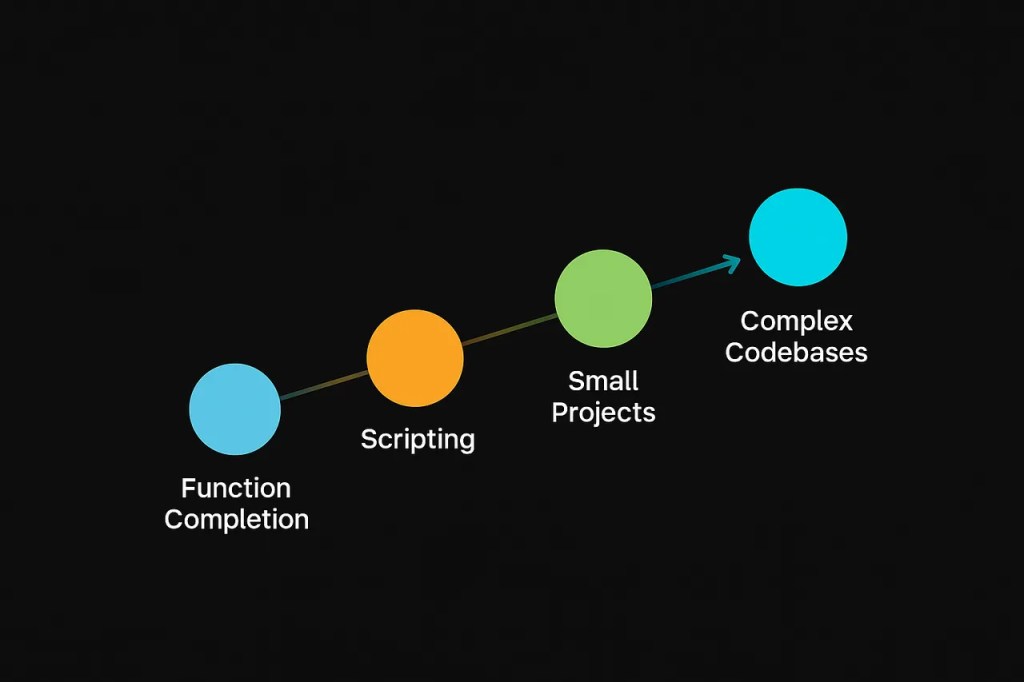
Timeline of coding agents showing milestones from basic function completion
to handling complex codebases.This steady climb may feel uneventful compared with flashy breakthroughs in chat or image generation, but it’s tangible. Working developers see their tools getting better month after month.
From autocomplete to autonomous agents
Command line coding agents are the biggest leap forward in recent years. A command line interface (CLI) is a text based way to control software. Instead of chatting in a web window, you install the agent locally and run it from your terminal. You give it access to your code repository, tests and tools. The agent reads your files, writes new code, runs tests and iterates until the task is done.
This workflow feels different from chatting with a model. You need to scope your problem clearly, just as you’d brief a human colleague, because the agent follows your instructions without further prompting. Adoption has been slower because these tools don’t look like the “superhuman coders” in marketing announcements. Yet they deliver meaningful gains. A niche problem that once took days can now be solved in hours.
One reason for the hype is that models like GPT 5 Codex recently achieved top scores at the ICPC World Finals, a prestigious programming contest. OpenAI’s researchers combined GPT 5 with an experimental reasoning model and answered 11 out of 12 algorithmic problems, outperforming human competitors. This impressive result shows how much raw ability is hidden in today’s models, but it also used far more computing power than most people will ever have access to. For everyday users, the real story is that coding agents quietly get better at solving practical tasks.
Choosing the right coding partner
There are several capable coding agents on the market. They often use similar large language models under the hood, so the differences come down to how they handle context and how much freedom they allow. Below is a simple overview:
- Claude Code and Codex CLI. These agents feel like a polished pair programming partner. They adapt how long they “think” based on the complexity of your problem and can run for hours on large tasks. Claude Code forces Anthropic’s premium model but delivers reliable results. GPT 5 Codex is cheaper and offers optional web search. Many developers switch between the two when one gets stuck.
- Cursor and GitHub Copilot. Cursor wraps an AI model inside a code editor and is good for quick fixes, but it can get distracted on complex tasks. GitHub Copilot is handy for autocompletions but struggles with larger projects.
Behind the scenes, product design and prompting matter more than raw model quality. Anthropic’s experience in extracting structured reasoning from their models gives Claude Code an edge, while OpenAI’s distribution means Codex has a broad user base and constant feedback. As competition heats up, expect rapid improvements driven by better task breakdowns rather than bigger models.
Why adoption still lags
If coding agents are so powerful, why aren’t they everywhere? Part of the answer lies in Canada’s broader AI landscape. An RBC Thought Leadership report notes that only about 12 percent of Canadian firms have integrated AI into their production or services, placing Canada among the lowest adopters in the OECD. Many businesses struggle to see AI’s relevance, face high upfront costs or simply don’t know where to begin. Yet those who do invest see tangible benefits: the same report found that 97% of AI adopting small and medium sized enterprises reported clear gains in productivity and efficiency.
Coding agents may feel unfamiliar today, but they follow a pattern seen in other tools: early skepticism gives way to widespread adoption once people experience the benefits. The gap between “superhuman coding” headlines and real world use is large, but it’s closing fast. The best way to understand these agent
Looking ahead: towards general agents
The evolution of coding agents points towards a future of general digital assistants. Today’s tools still ask for feedback or approval, especially when they get stuck. Over the next few years, asynchronous agents will handle more of the heavy lifting while interactive tools remain available for complex tasks. Eventually, coding may return to a familiar chat window, but behind the scenes a powerful agent will fetch code, run tests and deploy changes.
For now, the sweet spot lies in building mini projects. Entrepreneurs, students and researchers are using these tools to create websites, data dashboards and automation scripts in a fraction of the time. As adoption grows and products mature, the same approach will spread to larger systems.
Ready to build?
Coding agents are quietly reshaping how we work. Progress may feel incremental, but the impact is real. If you want to experience AI’s quiet revolution, start small: build a personal website, automate a task at work or clean up a messy spreadsheet using a command line agent. You’ll be surprised at how much it can handle.
To learn more about choosing the right model for your needs, read our guide on which AI model to use in 2025. For a deeper dive into how companies are building data driven AI solutions, explore our post on data driven AI for Canadian businesses. And if you’re curious about the latest breakthroughs, check out our article on GPT 5’s leap forward in AI capabilities.
Call to Action: Join the conversation! Have you tried a coding agent yet? Share your experiences in the comments or sign up for our newsletter to receive more AI insights. Your next big idea could be just a promp


Posted by